Marine Templates - stability, structural, powering, weights & moments, stability tests, time & project logs, owners requirements Savitsky planing semi-displacement semi-planning resistance

Hawaii Marine Templates
Economical and free Excel, MathCAD & Word processing templates that save time & money.  Those involved with the Nautical, Engineering & Professional Sectors will benefit from these products.  Products here are suitable for use by Naval Architects, Marine, Ocean, Nautical, Structural, Civil & Mechanical Engineers, Ship, Yacht & Boat Designers, Sailors, Vessel Owners & Operators, Boat Builders, Construction Contractors, Attorneys & other Professionals.

Excel spreadsheets MathCAD Word boilerplate trim stability area centroid moment of inertia section modulus metacenter tank capacity characteristics waterplane hydrostatics tow tug sail CFR 49 waterline

E-mail - hmt@hawaii-marine.com    Web Site - http://hawaii-marine.com/templates
45-302 Makalani St., Kaneohe, Hawaii, USA  96744-2819   Phone/Fax (808) 247-6443


Displacement &Semi-Displacement (or Semi-Planing) Boat Calculations (English Units)


Description:
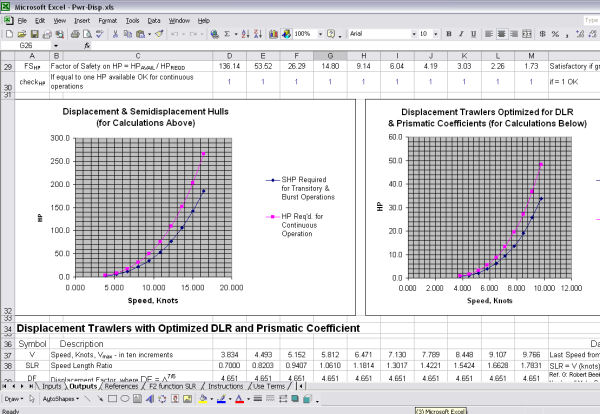
This popular boilerplate template performs powering calculations (power prediction methods) applicable to two modes of boat or ship operation.  The first is the displacement mode and the second involves semidisplacement or semiplaning mode of operation.  Result graphs are automatically generated and show speed in knots versus the brake horsepower required.  Because the input weight is important, this spreadsheet is setup to conveniently calculate the vessel's weight in various operational conditions.  This template also checks to see if the vessel will go it's intended range, if the installed horsepower is adequate and if the stern's quarter butt exit angle permits the input speed.

These calculations apply generally to calm water performance.  The first set of calculations are for most types displacement and semi-displacement, or semi-planing vessels.  They are based on procedures described by Dave Gerr in Reference D.  The second set of calculations applies only to displacement vessels (that are optimized for displacement length ratio and prismatic coefficient) and are adapted from methods presented by Robert Beebe in Reference K.  References D and K are recommended reading for understanding the processes automated in this spreadsheet.  The other references contain supplemental information, but they are not needed for implementation of these calculations.  This template is designed for use with English units.

The first set of output computations apply to displacement and semi-displacement vessels.  Semi-displacement, or semi-planing, boats normally operate at speed length ratios, V / LWL1/2, from about 1.3 to 1.4 all the way up to about three.  However, in order to reach speeds in excess of maximum displacement speed, a vessel must have the appropriate aft quarter butt exit angle. An example drawing of this exit angle is provided in the spreadsheet along within the output calculations.  If the aft quarter butt exit angle is too large, these calculations are automatically modified to only go up to the maximum speed that is allowable for the exit angle that is present.  However, the automated result will never be less than the maximum allowable displacement speed.  Since all this automated, a complete understanding is not crucial.  What must be understood is decreasing the hull exit angle will often let the spreadsheet evaluate higher speeds.

The second set output of calculations apply only to displacement mode.  Displacement ships can only go up to their maximum displacement speed which is calculated in this spreadsheet.  This maximum displacement speed is a function of both the weight and the length of the boat.  The maximum speed length ratio normally associated with displacement mode is usually between 1.3 and 1.4.  But light and long vessels can exceed this displacement limit and these effects are taken into consideration by this spreadsheet.    This second set of calculations assume that the boat has been designed with an optimum prismatic coefficient, that corresponds to it's displacement length ratio.  Beebe discusses these optimization techniques in References G and K.  Other references also discuss the technique.

There are several advantages and benefits associated with these calculative methods.  First this approach saves time.  Numerous computations are automatically and quickly done on your input data.  This approach is also cost effective because the calculations are already setup for you.  As a result your research time is minimized to familiarization of concepts when necessary and not in time consuming procedural development activities.
 

Electronic Document Type:  Microsoft Excel spreadsheet           Cost: $25 US funds
 

Number of Pages: Inputs Sheet, Outputs Sheet, References, Figure and Notes Sheet, F2 Function SLR Page, Use Terms Page and Instructions Page.      
               

Inputs:  

bullet

Hull characteristics
bullet

Length Over All, LOA, feet (optional input)

bullet

Length of Waterline, LWL, feet

bullet

Beam on Waterline, BWL, feet (optional input)

bullet

Exit Angle, qAFT, of Aft Quarter Butt, an explanatory diagram is provided on the References Sheet of this template.  This value is critical for proper hull operation and it is therefore checked in this analysis.  For complet details about this requirement refer to Pages 12 and 13 of Reference D. 

bullet

Weight information
bullet

Vessel light ship weight, pounds, the weight without any people, luggage, personal gear, provisions, stores, fluids or cargo on board

bullet

Weight margin on light ship, percent.  This is optional input and default values are provided.

bullet

Cargo weight, pounds, usually can be left at zero default value.  Examples of cargo weight are fuel drums on deck, weight of fish and ice on board.

bullet

Number of crew and number of passengers, integer

bullet

Additional equipment not included in light ship, pounds

bullet

Duration of voyage, days, for calculating provisions and stores, this value can often be left at it's default value which is equal to zero

bullet

Personal crew gear and passenger luggage, pounds, can be set to zero

bullet

Portions of total fluid capacities to be applied in analysis, default values that are set at 2/3 are provided, however these values may be specified as inputs.

bullet

Main propulsion fuel tank capacity, gallons, & fuel type (diesel or gasoline).  This is a highly recommended input value, if provided an estimate of the vessel's range will be automatically computed by this spreadsheet.

bullet

Potable water tank capacity, gallons

bullet

Sewage holding tank capacity, gallons

bullet

Propulsion Plant Details:
bullet

Installed brake horsepower, if unknown guess an amount, this value can be easily changed once these calculations are done.

bullet

Parasitic loads, horsepower, for pumps, generators, etc.

bullet

Continuous operating rpm, percentage of maximum, guideline values are given on the input sheet, simply select the applicable rpm percentage

bullet

Shafting efficiency, ratio, guideline values are given, select appropriate value

bullet

Propeller efficiency, ratio, a default value is present, however another value may be substituted in the calculations

bullet

Vessel range required, nautical miles, optional input.  If this value is specified this spreadsheet will automatically determine if the tanks provided are adequate to make the voyage distance specified by this input.

Outputs:  

bullet

For each of the input speeds the following is output are computed by this template:
bullet

Effective Horse Power, EHP

bullet

Brake Horse Power, BHP

bullet

Continuous Horsepower, BHP0

bullet

Estimated Range, nautical miles, from fuel consumption rate and tank capacity

bullet

The total operational weight is automatically computed based on light ship margin selected, cargo present, persons aboard, voyage duration which affects stores and provisions, selected operational tank capacities and gear on board.

bullet

Supplemental values like displacement length ratio, estimated maximum possible displacement speed, estimated fuel consumption rate, speed length ratios.

bullet

Calculative Checks are made for the following criteria:
bullet

Check if installed horsepower will meet the required horsepower needed for continuously operating at the speed computed.  It is important to know that If the speed involved is not a continuous operating speed this check should be ignored.  These speeds include those used for burst mode operation (operations only for short periods at this speed) and transitory speeds (when accelerating or decelerating towards a continuous operating speed).

bullet

Check if range requirements will be meet at the speed evaluated.  If this check is met the fuel tanks are adequately sized, if not the fuel tanks should be increased in size, but only for continuous operating speeds.

bullet

Check if hull bottom aft exit angle at quarter butt is appropriate for speed computed.  If this check is not met the bottom shape at the aft end of the hull should be flattened more so this speed can be reached by the hull.
 

Recommended Reading:

bullet

Reference D: Dave Gerr, Propeller Handbook, International Marine, 1989, Camden, Maine.

bullet

Reference E: Dave Gerr, Nature of Boats, International Marine, 1995, Camden, Maine.

bullet

Reference F: John Teale, article entitled "Teale on Trawlers," Motor Boating and Sailing, June 1981 issue.

bullet

Reference G: Robert P. Beebe, article entitled "Trawlers - Designing by the Numbers," Motor Boating and Sailing, January 1977 issue.

bullet

Reference H: Alfred D. Isaacson, paper entitled "Sewage Polution Control: A Guide for the Ship Owner & Design," SNAME Marine Technology, July 1977 issue..

bullet

Reference I: S9086-C6-STM-010/CH-096R1 "Naval Ships' Technical Manual Chapter 096 Weights & Stability," NAVSEA, 2 August 1996.

bullet

Reference J: Detroit Allison Diesel, article entitled "Calculating Hull Speed," Motor Boating and Sailing, February 1978 issue.

bullet

Reference K: Robert P. Beebe and James F. Leishman, Voyaging Under Power, Third Edition, International Marine, 1994, Camden, Maine.

Terms: Prior to purchase, read our End User License Terms.

Important Notice to European Union Buyers: Due to changes in international law, we no longer accept purchases from any individuals located within an EU country.  However, businesses located within the EU are allowed to make purchases, provided that they make the VAT payments for any imported items purchased electronically.  These EU businesses must specify their VAT number in the memo section on the Paypal payment pages.  These changes are effective as of July 1, 2008, and were modified for EU businesses on April 9, 2010.  

Download Now: click the following hyperlink to pay $25 fee and then immediately download the zip file containing the template.

Minimum System Requirements: Windows 95/98/NT/2000/XP/Vista/Windows7

Customer comments regarding this product can be viewed by clicking here.

Sample: A sample of an output page is shown below.


horizontal rule


horizontal rule


Copyright © 1997- 2010 Hawaii Marine Company, 45-302 Makalani St., Kaneohe, HI   96744 - 2819 
U. S. A.   Phone/Fax Line: (808) 247-6443  
Emergencies (808) 291-0348.  This site last modified on: 08/30/10 11:44 PM.

emailCLR.gif (4349 bytes)

This web site created and marketed by Advanced Technology Associates Hawaii.  For questions or comments about this web site send e-mail to Brian Trenhaile at bt@atah.net.

flowani.gif (14628 bytes)

eXTReMe Tracker